Loneliness, Companionship and AI: A Careful Reading
A companion chat is conversation, and conversation is genuinely good for people — that is a reasonable claim. What it is not is a treatment, a substitute for friendships or a cure for anything. Reading the category carefully means separating three things that get bundled together: the value of routine, the limits of a generated text partner, and the point at which either of those stops being enough.

Key takeaways
- A companion chat offers availability, low stakes and no scheduling. Those are real benefits and they are not the same as intimacy with a person.
- Crushon states that its material is AI-generated text and depicts no real person, per its 2257 compliance statement updated 8 Feb 2025 — worth holding in mind whenever a message feels personal.
- Count both sides of the ledger: 16 sessions of half an hour is 8.0 hours a month, and any honest reading compares that with time spent with people.
- No health claims are made here, and readers who are struggling should look to human support rather than to a service of this kind.
What a companion chat can reasonably offer
Start with the things that are true and modest. A chat is available when you are. It does not cancel, it does not need to be impressed, and it costs nothing emotionally to leave a session early. For someone whose evenings are quiet, a place to type regularly can fill a gap that has nothing to do with adult content: the gap of having something to say.
The platform's Porn Chat AI description lists customisable characters, a private and secure environment with state-of-the-art encryption, and natural, adaptive responses that recall earlier interactions and express emotion over time. Read literally, those are statements about the software — what it is designed to do — and they describe a responsive text partner, not a relationship.
There is also a skills argument worth making carefully. Talking about what you want, correcting a tone, keeping a scene coherent: those are conversational habits, and practising them in a low-stakes place is not absurd. It becomes a problem when practice replaces the thing being practised, and that is the line this article is about.
The limits, stated plainly
The first limit is generatedness. The words come from a model, and the platform's own compliance statement is explicit that the content is AI-generated text depicting no real person. Nothing a character says is testimony from anyone. That does not make a pleasant exchange worthless; it does make any interpretation of it as reciprocal affection a misreading.
The second limit is availability disguised as attention. A character is always ready because it has no other commitments, and the warmth that always-availability produces is a feature of the design rather than evidence of care. Recognising that is the difference between enjoying a session and mistaking it for something it cannot be.
The third limit is feedback. People who know you can be surprised by you, disagree with you and change over time. A generated partner adapts to you, which is comfortable and narrow. If all your regular conversation is with something that adapts to you, the range of what you encounter shrinks.
| Dimension | What a chat can do | What it cannot do | Signal to watch |
|---|---|---|---|
| Availability | Respond whenever you open it | Be changed by missing you | Time spent rising while human contact stays flat |
| Reciprocity | Reproduce conversational warmth | Hold an independent point of view | Whether you can be genuinely surprised |
| Routine | Give structure to an empty evening | Substitute for plans with people | How many weeks since you last met someone |
| Disclosure | Offer a private space to think out loud | Offer help a person could give | Whether you would tell a friend the same thing |
| Content | Generated text written on request | Depict or involve any real person | Whether any claim of reality comes from you or the service |
Worked example: putting both sides on one sheet
Take an illustrative reader with a settled habit: four sessions a week at 30 minutes each. That is 16 sessions a month, so 480 minutes, or 8.0 hours. If those sessions were 15 minutes each the month would be 4.0 hours, and at 60 minutes each it would be 16.0 hours. Nothing about the platform changes across those three columns; only the habit does.
Now write a second column for time with people: a fortnightly two-hour evening with friends is 4 hours a month, one weekly hour is about 4.3 hours, and a monthly family visit of three hours is 3 hours. The comparison is not a rule and it does not need to be a competition, but the two columns side by side answer a question that no amount of reflection answers reliably.
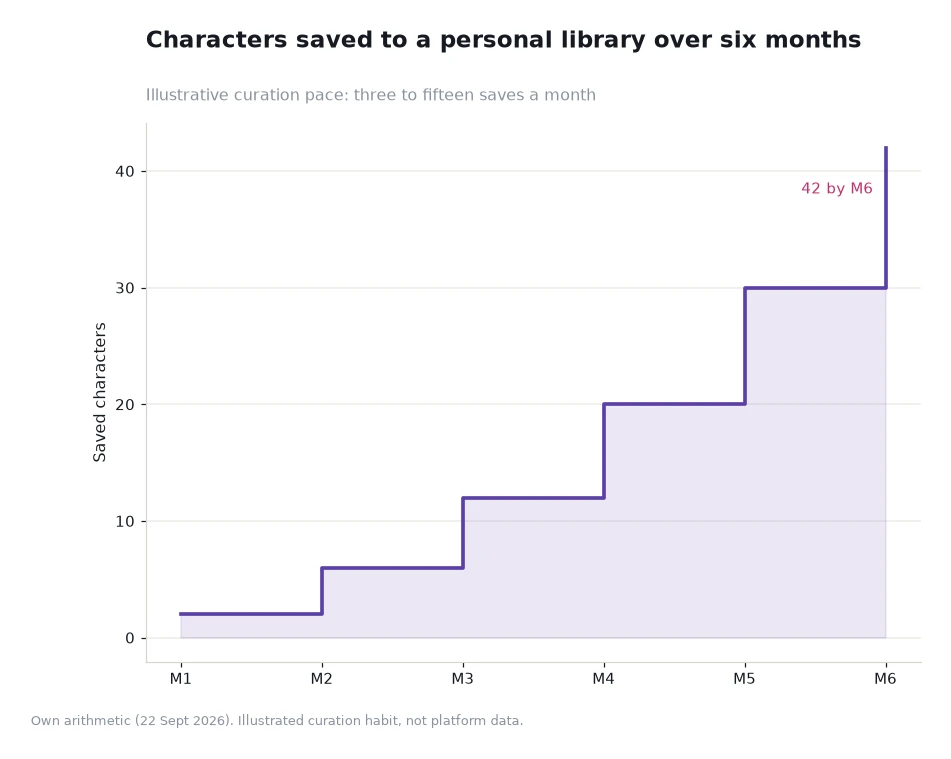
The third column is the library. Suppose six months of use leaves 42 saved characters, following an illustrative curve of 2, 6, 12, 20, 30 and 42. That number describes returning, not relating — and treating it as a measure of social life would be a category error, which is precisely the kind of slippage careful reading is meant to prevent.
Where the line actually sits
The line is not about minutes. Plenty of people spend more time watching television than talking to friends, and nobody reads a health warning into that. The line is about whether the chat is one thing among several or the only thing — whether it crowds out alternatives or fits alongside them.
Two questions make that practical. Did the habit displace anything you miss? And would you be comfortable describing it to someone who knows you? If the answer to the first is yes, the response is not to delete an account but to book something with a person and see whether the sessions shrink on their own. If the answer to the second is no, ask what you would want the other person to understand, because that is usually the useful part.
It also helps to vary what you open. A habit built entirely on one character is closer to a routine than a range, and the character search page makes it easy to try a different kind of conversation without dismantling the one you like. Widening the range is the cheapest way to notice that a single entry has become the whole of your use.
There is also a support question that deserves a plain answer rather than a careful one. A platform like this is not a counselling service and does not present itself as one, whatever its characters claim inside a scene. Adults who are struggling with loneliness should treat a chat service as pleasant company at best, and look for human help — a friend, a family member, a doctor or a local service — for anything that lasts more than a passing mood.
The ai porn chat page is the right place to read what the operator actually claims, in its own words, including the note that some limitations apply under its content and community guidelines. Read against expectations rather than hopes, the description is modest, and holding a modest description to a careful standard is the whole of this article's argument.
Frequently asked questions
Is talking to an AI companion harmful?
There is no universal answer in either direction, and anyone offering one is overreaching. What can be checked is displacement, secrecy and whether the habit is more or less than you intended.
Can a chat partner replace a friendship?
No. It can be pleasant, available and interesting. Mutual care, surprise and obligation belong to people, and a generated reply is not a substitute for any of the three.
Is the content real people?
It is not. The platform's compliance statement says the material is AI-generated text and depicts no real person, and the statement carries a February 2025 update date.
A measured way to keep it
Keep the habit if it is one column out of several. Check it once a month against the two questions above rather than every evening, decide what you want from it, and be explicit about what it cannot give you. The writing on the AI chat blog is a reasonable place to see how the operator frames its own product, and reading a description written for its users is a useful counterweight to the way a habit feels on a quiet night. That is a more durable arrangement than either enthusiasm or alarm.
And if the honest reading is that it has become the only column, treat that as information rather than as a failure. Book something with a person this week, then look at the numbers again next month and see whether they moved. If you need help that a chat cannot give, speak to someone who can.
Data and sources: the platform's compliance statement, dated 8 Feb 2025, and the service description and FAQ wording on its adult chat pages[1], read 22 Sept 2026. Time and library figures are worked examples about a habit, not platform measurements, and this article makes no health or outcome claims of any kind. Written for an adult audience, 18+, and not a substitute for professional support; read 22 Sept 2026.