A Practical Guide to Reviewing Factory Capacity and Production Records
A factory’s stated capacity is useful only when it is available for the buyer’s product, quantity, and delivery window. Review production records, active order loading, bottlenecks, materials, staffing, and conforming output. Capacity should be a documented assessment with assumptions, not a single number in a sales presentation.
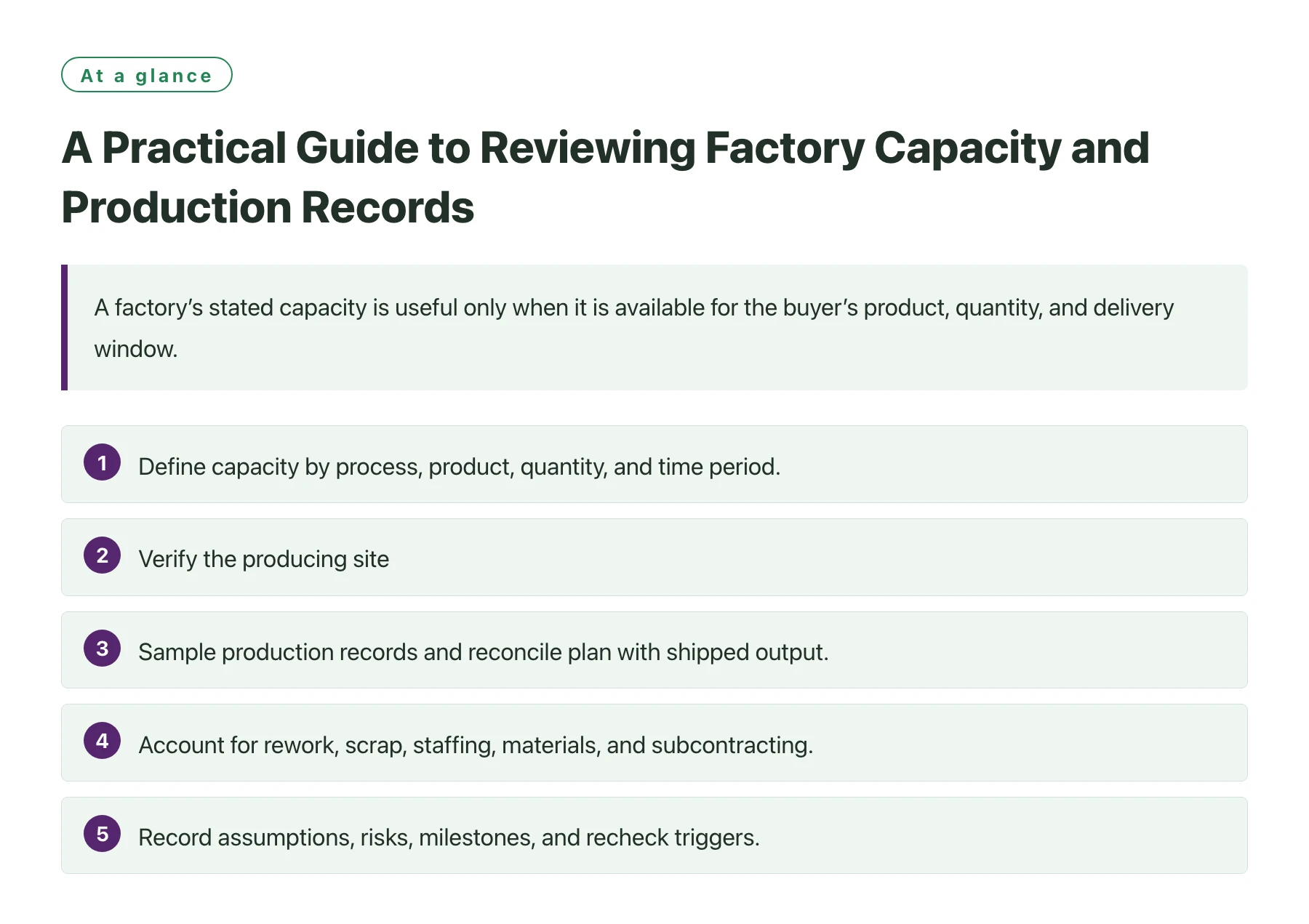
Key takeaways
- Define capacity by process, product, quantity, and time period.
- Verify the producing site, resources, schedules, and active commitments.
- Sample production records and reconcile plan with shipped output.
- Account for rework, scrap, staffing, materials, and subcontracting.
- Record assumptions, risks, milestones, and recheck triggers.
Capacity evidence should connect available resources to the buyer’s exact order and schedule.
1. Define which capacity matters
State product, process, quantity, shipment date, shifts, and requested output. A factory’s total monthly capacity may not represent available capacity for a particular line or order. Ask for capacity by process step and identify bottlenecks, changeover time, maintenance, and other committed customers.
Confirm whether quoted volume refers to theoretical machine output, planned production, or actual conforming goods shipped. Require the supplier to state the assumptions and period used.
2. Verify the producing site and resources
Name the actual production address and map processes across company-owned or subcontracted locations. Review relevant equipment, tooling, workstations, storage, utilities, and maintenance arrangements. Compare equipment observed with the route and process plan for the quoted product.
Ask who owns, operates, maintains, and schedules critical equipment. If capacity depends on a subcontractor, identify its role and what evidence is available. A sales office’s brochure is not proof of the capacity at the producing site.
3. Review production plans and order loading
Request a current production schedule with order identifiers, stages, quantities, planned dates, and completion status. Check the schedule against capacity, labor, material availability, and inspection holds. Sample work orders or traveler records to see how planned work is recorded and updated.
Look for bottlenecks caused by shared equipment, seasonal peaks, changeovers, or outsourced processes. Ask how the factory handles missed milestones and what recovery options are realistic without bypassing quality controls.
4. Sample records from actual orders
Select completed and active orders relevant to the product. Review work orders, output reports, downtime records, rework, scrap, quality checks, dispatch quantities, and shipment dates. Trace a few quantities from plan to finished goods and shipping documents.
ISO 9001:2026 specifies quality management system requirements; system records can help assess planning and control, but they do not prove that every quoted capacity figure or current order is accurate. Match sampled records to the site, process, product, and period. [1]
5. Check yield, rework, and quality-adjusted output
Distinguish gross production from conforming output after rework, scrap, and final inspection. Ask how the supplier calculates yield and what time period or product family it covers. Compare quality trends to the proposed lot size and deadline.
A high output rate that depends on frequent rework may create schedule and defect risk. Review how rejected units are identified and whether replacement capacity is included. Do not treat a supplier’s best day or machine speed as sustained production performance.
6. Evaluate labor and skill coverage
Check planned operators, training, shift handover, supervisor coverage, and specialist roles required for the product. Ask whether new or temporary labor is expected and how competence is confirmed. Review any critical tasks that rely on one operator or one maintenance technician.
For multi-shift production, compare records and quality results across shifts. Confirm that work instructions, inspection methods, and escalation routes are consistent. Identify training or staffing gaps that need closure before ramp-up.
7. Confirm materials and external dependencies
List critical materials and components, supplier lead times, approved sources, current stock, and incoming inspection status. Ask which parts are long-lead or single-source and whether the buyer’s requested delivery relies on unconfirmed supply.
Map subcontracted operations, external tests, finishing, or packaging. Obtain schedule evidence and define who follows up with each provider. A factory cannot deliver finished goods on the promised date if a critical process or input is not secured.
8. Make a capacity decision with conditions
Compare the evidence with required quantity, milestones, quality history, and contingency. Record confirmed capacity, assumptions, unverified claims, and conditions such as a pilot run, additional shift, approved subcontractor, or material reservation.
Recheck capacity after order changes, production delays, equipment failure, or site changes. Assign the buyer contact who receives regular progress evidence and can escalate a variance.
9. Use structured verification support
A site visit can compare stated capacity with actual equipment, schedules, people, and production records. Define evidence access, sampled orders, reporting, and limitations before the visit. Do not ask an inspector to certify an estimate the underlying records cannot support.
Buyers arranging Shanghai JS Sourcing can request help organizing a capacity review and production follow-up, while retaining the decision about acceptable delivery risk and supplier approval.
Sources
Frequently asked questions
How can a buyer verify factory capacity?
Compare planned output with site resources, active order loading, materials, staffing, process bottlenecks, quality yield, and records from actual production.
Is machine capacity the same as available order capacity?
No. Existing orders, setup, maintenance, shifts, material supply, subcontracting, and conforming yield affect what can be delivered.
Which production records are useful to review?
Sample work orders, schedules, output, downtime, rework, scrap, inspections, dispatches, and shipment records tied to the same product and site.
Should a buyer accept an unverified capacity promise?
Treat it as an open risk. Ask for supporting evidence, conditions, a realistic milestone plan, and a contingency before approving the date.